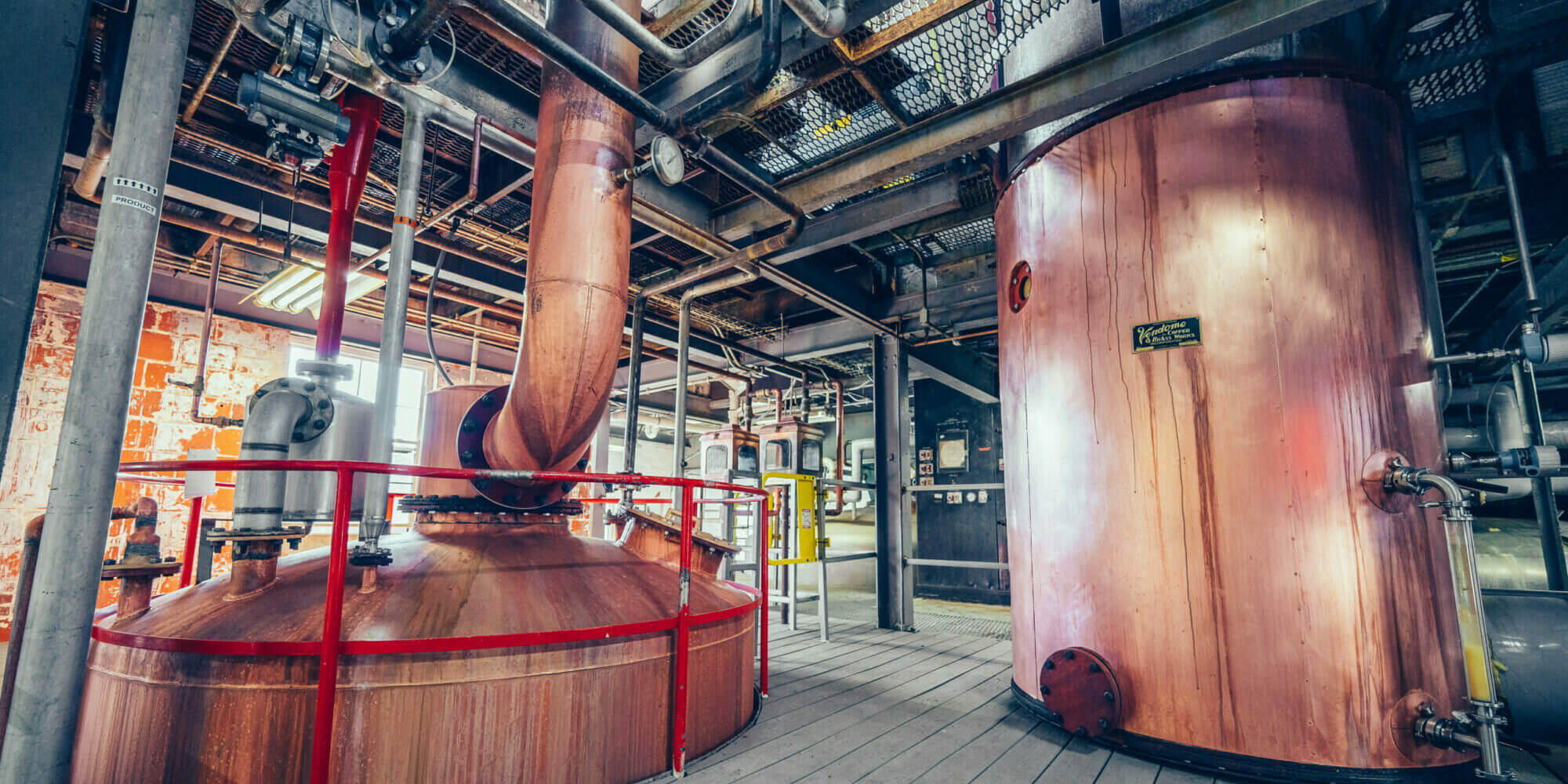
Large copper stills and fermentation tanks with red railings inside an industrial distillery or brewery facility
Two ice cubes go into a pour of bourbon. Ten seconds later the glass looks hazy. Milky, almost. Most of us hit this moment at least once and ask the same thing: is this bad?
No. It’s safe. It’s normal. And it usually traces back to one production choice, filtration.
That’s the short answer to why is bourbon cloudy. The longer answer involves cold, a little chemistry, and a label phrase that trips up plenty of shoppers: non chill filtered bourbon. Here’s what it means in plain English, why the haze shows up, and whether any of it changes the taste.
Cloudy Bourbon Isn’t Broken Bourbon
Bourbon holds more than ethanol and water. It carries natural fatty acids, esters, and proteins, and those compounds supply a good share of its flavor and texture.
They come from three places. Grain brings oils and proteins. Fermentation produces esters, the compounds behind fruity notes like banana and pear. Barrel time adds more as the spirit soaks into charred oak and pulls flavor back out.
When the whiskey stays warm enough and strong enough, those compounds stay dissolved. Lower the temperature or the proof, and some fall out of solution. That’s the haze.
So cloudiness is cosmetic, not a safety issue. Nothing spoiled. Nothing got in. We let the glass sit a few minutes, and the haze often clears as the bourbon warms.
What Is Chill Filtering, Anyway?
So what is chill filtering? It’s an extra step some distilleries take right before bottling.
Distillers cool the bourbon to near or below freezing. At that temperature, the haze-causing compounds clump together. Fine filters then catch the clumps. The whiskey that comes out stays clear on the shelf, in the bottle, and in a cold glass. Whisky Advocate covers the science in more detail for anyone who wants the chemistry.
The point is consistency. A chill filtered bottle looks the same in a hot July liquor store and a cold January basement bar. Cold. Clump. Catch.
The Flocking Problem It Solves
Skip chill filtering, and bottles stored in the cold sometimes grow “floc.” That’s the trade term for wispy sediment floating in the bottle. Tiny white threads nobody ordered.
Floc does no harm. Perception is the problem. A shopper spots it, assumes contamination or a flaw, and puts the bottle back. Some people return it. So plenty of distillers chill filter for cleaner looks, fewer complaints, and bottles that match each other.
What Makes Non-Chill Filtered Bourbon Different
Distillers still filter non chill filtered bourbon. A basic pass removes barrel char, wood bits, and other debris. Nobody wants charcoal flakes in a pour.
The difference? They skip the deep-cold step. That leaves more oils, fatty acids, and esters in the whiskey.
Fans make two common claims. Fuller mouthfeel. More texture on the palate. In practice, the pour coats the tongue and hangs around instead of slipping past.
One label note. “Unfiltered” on a bottle usually means minimally filtered, not zero filtration. The TTB sets the federal standards for what bourbon must be, but terms like “unfiltered” and “non-chill filtered” don’t follow one strict industry definition. We read the fine print and check what the distillery says about its own process.
Why Is Bourbon Cloudy? Cold, Water, and Proof
Three things decide whether haze appears: temperature, dilution, and proof. Cold bourbon holds fewer compounds in solution. Water lowers the alcohol. A lower starting proof leaves less cushion. Stack two of those together and the odds of a cloudy glass climb fast.
Bourbon Louching: What Happens When You Add Water or Ice
Bourbon louching takes its name from absinthe. Absinthe drinkers pour cold water into the spirit and watch it turn milky. They call that effect the “louche.”
Bourbon does a quieter version. Alcohol keeps oils and esters dissolved. Add water and the alcohol percentage falls. Past a certain point, those compounds can’t stay in solution, so they form tiny droplets that scatter light. Hazy glass.
Ice works faster because it delivers cold and water at the same time. That’s why a non-chill filtered bourbon on the rocks often clouds up quicker than the same pour with a splash of room-temperature water.
The 46% ABV Line
Around 46% ABV, or 92 proof, haze compounds generally stay dissolved at room and shelf temperatures. Above that line, the alcohol handles the job chill filtering would otherwise do.
That’s why so many higher-proof bottles skip chill filtration. The distiller doesn’t need it for a clear bottle, and more oils and esters stay put.
Our full-proof bourbon and higher-strength single-barrel picks sit on that side of the line. More strength, more flavor per sip, and a pour that keeps its body after a few drops of water or one cube.
Chill Filtered vs Unfiltered Whiskey: Does It Taste Different?
Ask a table of bourbon drinkers about non-chill filtered pours and the same words come up. Oilier. Rounder. More weight on the tongue.
Here’s the catch. Proof often matters more than filtration. A 110-proof bourbon tastes bigger than an 86-proof one, filtered or not. Putting an 80-proof chill filtered bottle next to a barrel-proof non-chill filtered one tells us about strength, not filters.
Blind tastings bear that out. When tasters compare the same whiskey at the same proof, with and without chill filtration, the results don’t always produce a clear winner. Some pick the unfiltered glass. Some can’t tell. Some prefer the cleaner one.
So the chill filtered vs unfiltered whiskey debate comes down to taste. Not a rule. No wrong answer.
How We Think About Picking a Bottle
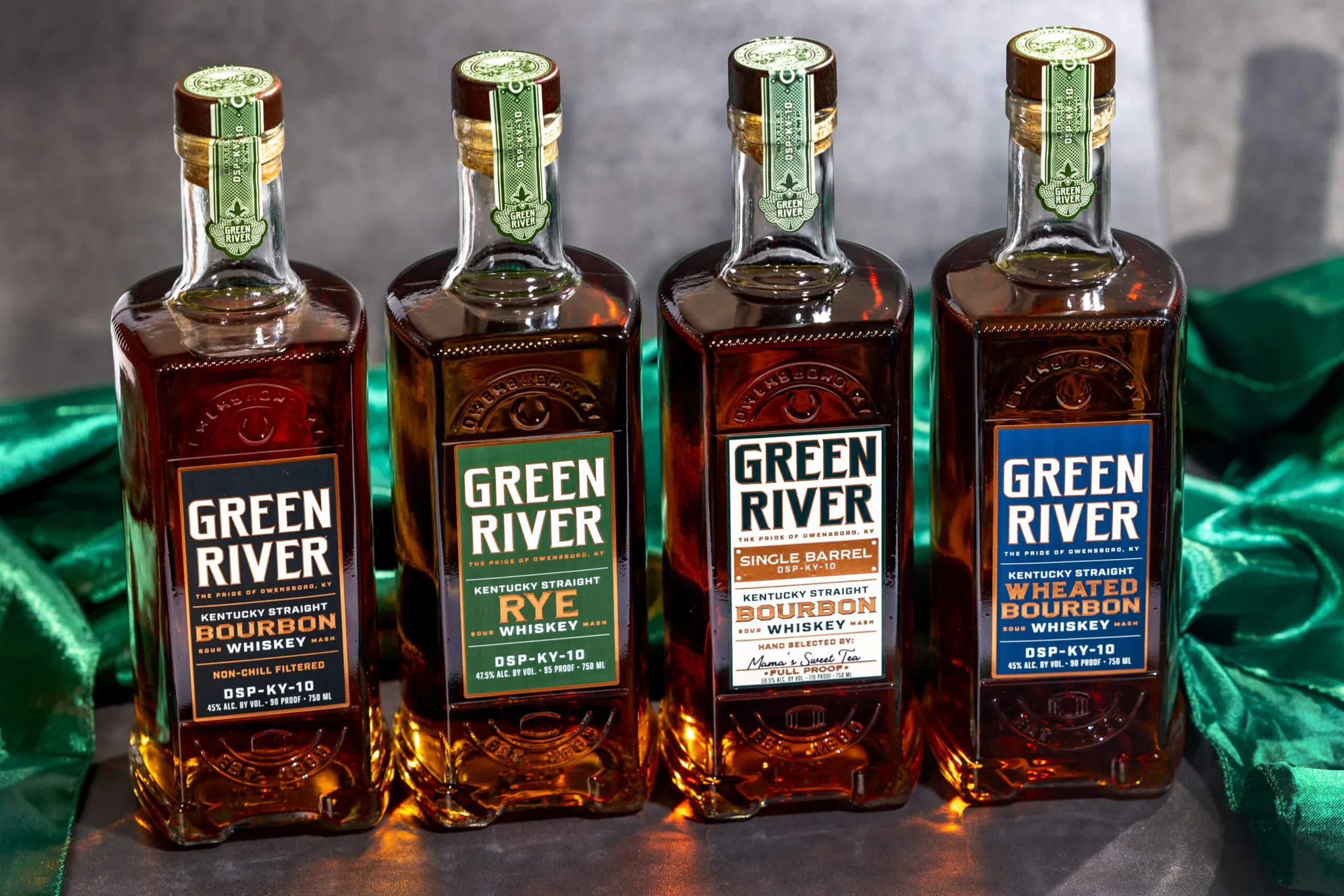
Four Green River whiskey bottles lined up showing different expressions including rye and single barrel varieties
We start with the label. Proof tells us plenty. Filtration details help when the distillery lists them. If proof or mash bill still feels fuzzy, our guide to bourbon proof and mash bills covers the basics faster than any front-label slogan.
Then we pick by occasion:
- Neat sipping: A higher-proof, non-chill filtered bottle shows off texture and depth.
- On the rocks: Expect haze from most non-chill filtered bourbon. That’s fine. Higher proof holds up better as the ice melts.
- Cocktails: Proof and flavor matter more than filtration. A bolder pour stands up to sweet vermouth, bitters, or citrus.
Clarity in the glass shouldn’t drive the choice. A crystal-clear pour says nothing about flavor. A hazy one says nothing bad.
That’s where our full-proof and single-barrel bourbons fit in. More strength and more character at a fair price. No fancy box. No lottery to buy a bottle.
FAQs About Non-Chill Filtered and Cloudy Bourbon
Is cloudy bourbon safe to drink?
Yes. The haze comes from natural compounds out of the grain, fermentation, and barrel. It signals no spoilage and no contamination.
Does non-chill filtered bourbon taste better?
Some drinkers notice a fuller, oilier texture. Others notice little difference. Better comes down to personal preference.
Why does my bourbon get cloudy when I add ice?
Ice brings cold and dilution at once. Both push fatty acids and esters out of solution, and the pour turns hazy.
How do I know if a bourbon is chill filtered?
Check the label wording first. Then look at proof, since many bottles above 92 proof skip chill filtering. Distillery product pages often list filtration details too.
Will the cloudiness go away?
Often, yes. As the pour warms toward room temperature, the compounds dissolve again and the haze fades.
A cloudy bourbon means nothing went wrong. The distillery left more in and stripped less out.
Filtration is one detail among many. Proof, mash bill, and age shape flavor at least as much. Pour what tastes good, the way it tastes best, and enjoy it responsibly.
Explore our full-proof and single-barrel bourbons, or visit our Louisville tasting room to try them side by side.